Optimising fluid flows: finding the most effective disturbances
Undergraduate Project 2026-27 (4H)
Fluid flows are everywhere — from the atmosphere and oceans to aircraft and wind turbines. In many situations, we are not just interested in predicting a flow, but in optimising it.
For example:
- How can we design a wing to reduce drag or maximise lift?
- What flow disturbance leads to the strongest mixing?
- Which small perturbation can grow the most and trigger instability?
At the heart of these questions is a simple but powerful idea:
Among all possible inputs, which set of them produces the largest effect?
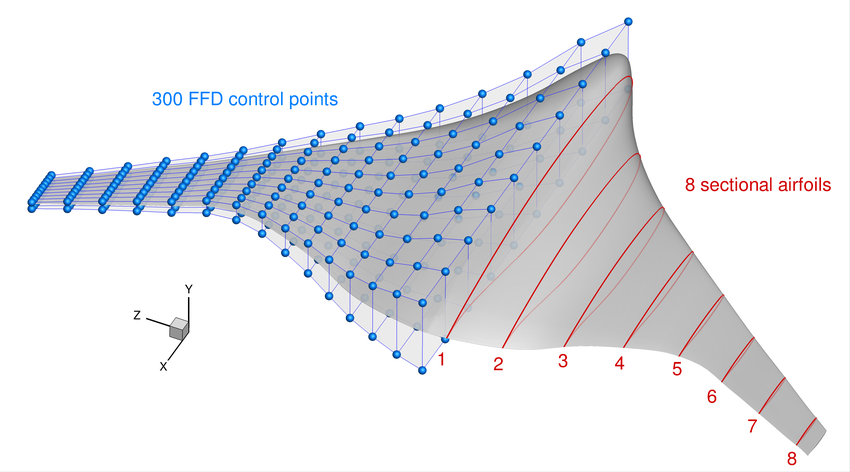
In engineering, this idea is used to optimise shapes such as aircraft wings. In fluid dynamics, it is used to identify disturbances that can grow rapidly and influence the entire flow.
What is this project about?
This project explores how such optimisation problems can be understood using ideas from mathematics and fluid dynamics.
In particular, you will investigate:
- how to define and measure “growth of energy or instability” in a flow
- how to find the most amplified disturbance
- how optimisation problems can sometimes be reduced to surprisingly simple mathematical structures
A key theme is that, although fluid flows can be very complex, the search for optimal disturbances often reveals a hidden simplicity.
How does this connect to modern methods?
A widely used approach in fluid dynamics is adjoint-based optimisation, which is used in areas such as: aerodynamic design and weather and climate modelling. This short video can help you to get an idea about an application of adjoint-based optimisation:
One of the interesting aspects of this project is understanding how these modern optimisation methods connect to more classical ideas from linear algebra and stability theory.
What will you do?
Depending on your interests, the project may involve:
- working through simple mathematical models of fluid flow
- exploring optimisation problems in a simplified setting
- running small numerical experiments
- interpreting the results in terms of physical flow behaviour
The project can be adapted to be more theoretical or more computational.
Mode of operation and evidence of learning
The project will revolve around learning through reading, mathematical analysis, and programming in Python or MATLAB. Students will explore simplified optimisation problems arising in fluid dynamics and investigate how optimal disturbances can be identified numerically.
Students will demonstrate their understanding by implementing and analysing numerical methods, comparing their results with theoretical predictions and published studies, and interpreting the physical meaning of the computed optimal structures. This will include clearly communicating the material in both written and oral formats.
Prerequisites/Corequisites
This project requires background in fluid dynamics and numerical methods as well as programming experience. Fluid III is a strict requirement.
References
[1] Butler, K. M. and Farrell, B. F., 1992: Three-dimensional optimal perturbations in viscous shear flow. Phys. Fluids A, 4, 1637–1650.
[2] Reddy, S. C. and Henningson, D. S., 1993: Energy growth in viscous channel flows. J. Fluid Mech., 252, 209–238.
[3] Schmid, P. J., 2007: Nonmodal stability theory. Annu. Rev. Fluid Mech., 39, 129–162.
[4] Golub, G. H. and Van Loan, C. F.: Matrix Computations (sections on singular value decomposition).